
gender workshop series | Special session
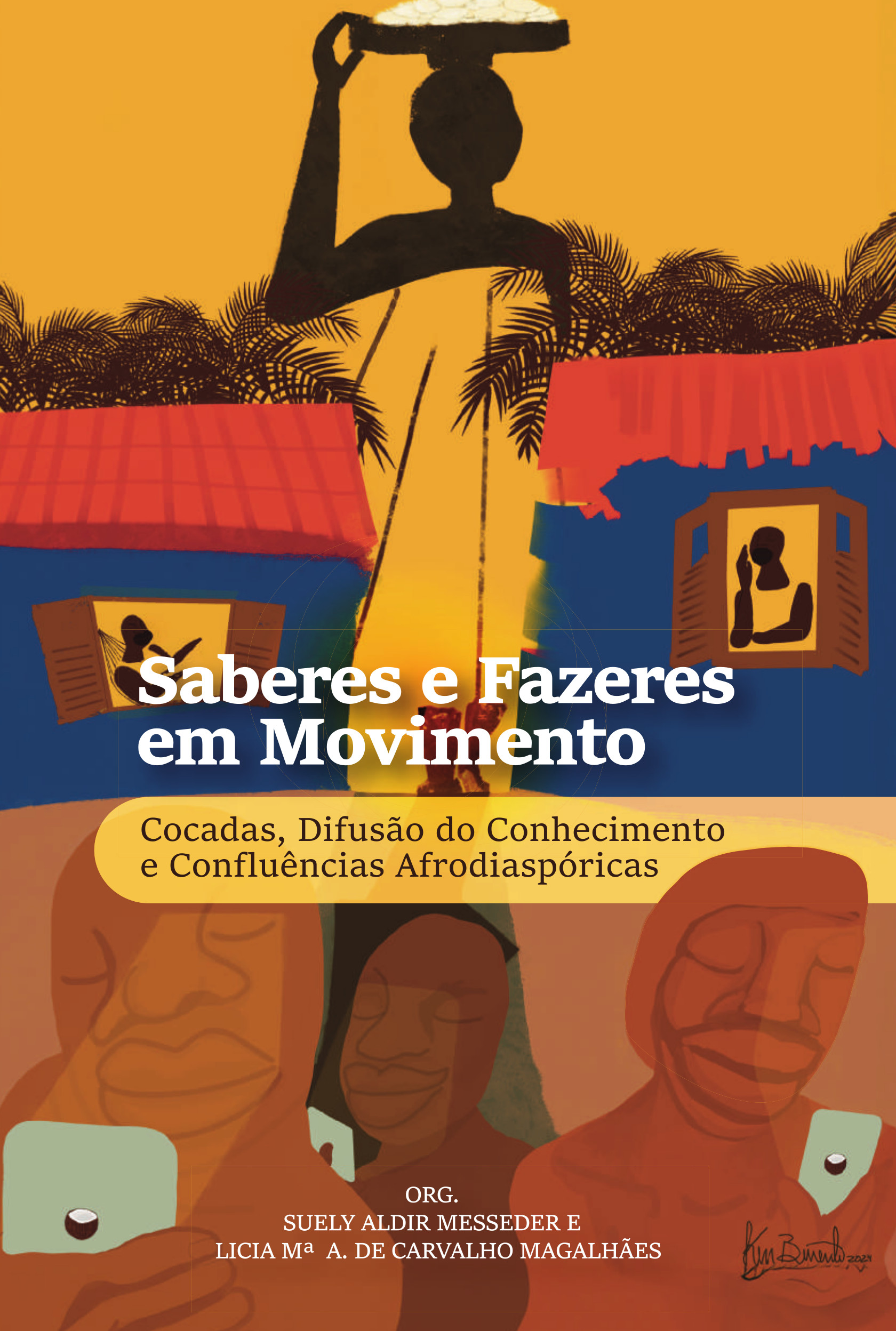
Presentation of the book «Saberes e Fazeres em Movimento: Cocadas, Difusão do Conhecimento e Confluências Afrodiaspóricas» | Eds. Suely Aldir Messeder and Lícia Maria de Carvalho
May 7, 2026, 17h00
Room 2, CES | Alta
Book presentation by Suely Messeder (Author/UNEB) and Catarina Caldeira Martins (CES/FLUC)
About the book
The book Saberes e Fazeres em Movimento: Cocadas, Difusão do Conhecimento e Confluências Afrodiaspóricas, edited by Suely Aldir Messeder and Lícia Maria de Carvalho, and dedicated to women who make cocadas, is structured as a journey in which each chapter affirms women as subjects of knowledge and recognises students and young people from the communities as local researchers.
In the opening, a decisive gesture is made explicit. Adriana Marmori, in her capacity as rector (UNEB) - a representative of the hierarchy of academic knowledge - appears side by side with D. Maria, a local woman who teaches through practice and attentiveness. By placing them on an equal footing, the book creates a rupture: it is not a matter of bringing distinct forms of knowledges together, but of affirming their epistemic equivalence. It is in this rupture that the foundation of the work lies.
In the chapters on Monte Gordo, the students - Nicole, Suene, Ana Vitória, Sara, Natalícia - and the young men Caio, Lucas and Gildevan take centre stage. They do not operate as neutral mediators, but as local researchers, deeply involved. The women cocadeiras, especially the older ones, emerge as repositories of knowledge. Here, there is a dual shift: the women cease to be objects and become authors; and the students cease to be passive learners to become producers of reading and writing about the territory.
In dialogue with the Postgraduate Programmes in Knowledge Dissemination and Post-Critique, the book deepens its theoretical framework. The dissemination of knowledge is treated as a situated practice, traversed by power relations, but also by possibilities of displacement. Women appear as epistemic agents who challenge the criteria for validating academic knowledge, expanding its boundaries.
The chapter set in Mozambique, featuring Sandra and Nelson, broadens the scope without losing sight of the core principle. Local women are recognised as intellectuals in their own right, in convergence with the Bahian ‘cocadeiras’. Young local researchers act as bridges, not to translate hierarchically, but to sustain the horizontal circulation of knowledges. The Afro-diaspora thus emerges as a field of equivalence rather than subordination.
Bio notes
Suely Aldir Messeder holds a bachelor’s degree in Social Sciences from the Federal University of Bahia (UFBA), a master’s degree from the Postgraduate Programme in Social Sciences at UFBA, and a PhD in Anthropology from the University of Santiago de Compostela, recognised in Brazil by the Postgraduate Programme in Anthropology at UFBA. She is a full professor at the State University of Bahia (UNEB). She was the manager of Affirmative Action at UNEB, coordinator of the Multi-institutional and Multidisciplinary PhD Programme in Knowledge Dissemination, and a permanent lecturer on the Postgraduate Programme in Cultural Criticism at Campus II Alagoinhas. She is currently the coordinator of the UNEB Innovation Agency and is a member of the Editorial Board for Scientific Journals of the Brazilian Association of Anthropology (ABA). Messeder is the coordinator of the Enlace Research Group and served as first secretary of the Brazilian Association for Homoculture Studies (ABEH) during the 2010-2012 term. She also served as manager of the Technical Cooperation Agreement between the Public Prosecutor’s Office and the State University of Bahia. She is currently a member of the Basic Chamber for Technical Advice and Evaluation of the Bahia State Research Support Foundation (FAPESB). Her interests in teaching, research, and outreach encompass gender and race relations, knowledge management and dissemination, social entrepreneurship, social technology, and literacy. She developed the Saberes e Fazeres Digital Museum in Bahia and the narrative digital game Cocada de Dona Maria.
Catarina Caldeira Martins is an Associate Professor with Habilitation at the Department of Languages, Literatures and Cultures at the Faculty of Arts and Humanities, University of Coimbra, and a researcher at the Centre for Social Studies. She was a lecturer for several years at Cheikh Anta Diop University in Dakar. She holds a PhD in German Literature from the University of Coimbra (2008) and is a Professor with Habilitation in Cultural and Literary Studies, with a focus on feminist and postcolonial studies. She has published on topics related to feminist and postcolonial studies, comparative literature, German-language literature, and African literatures, particularly by women. Her current areas of research include decolonial and feminist studies, with a focus on themes and issues in literature and culture. She teaches on the doctoral programmes in Feminist Studies, Discourses: History, Culture and Society, and Literature and Cultural Studies. She is Director of the CES Collection.