
Workshop
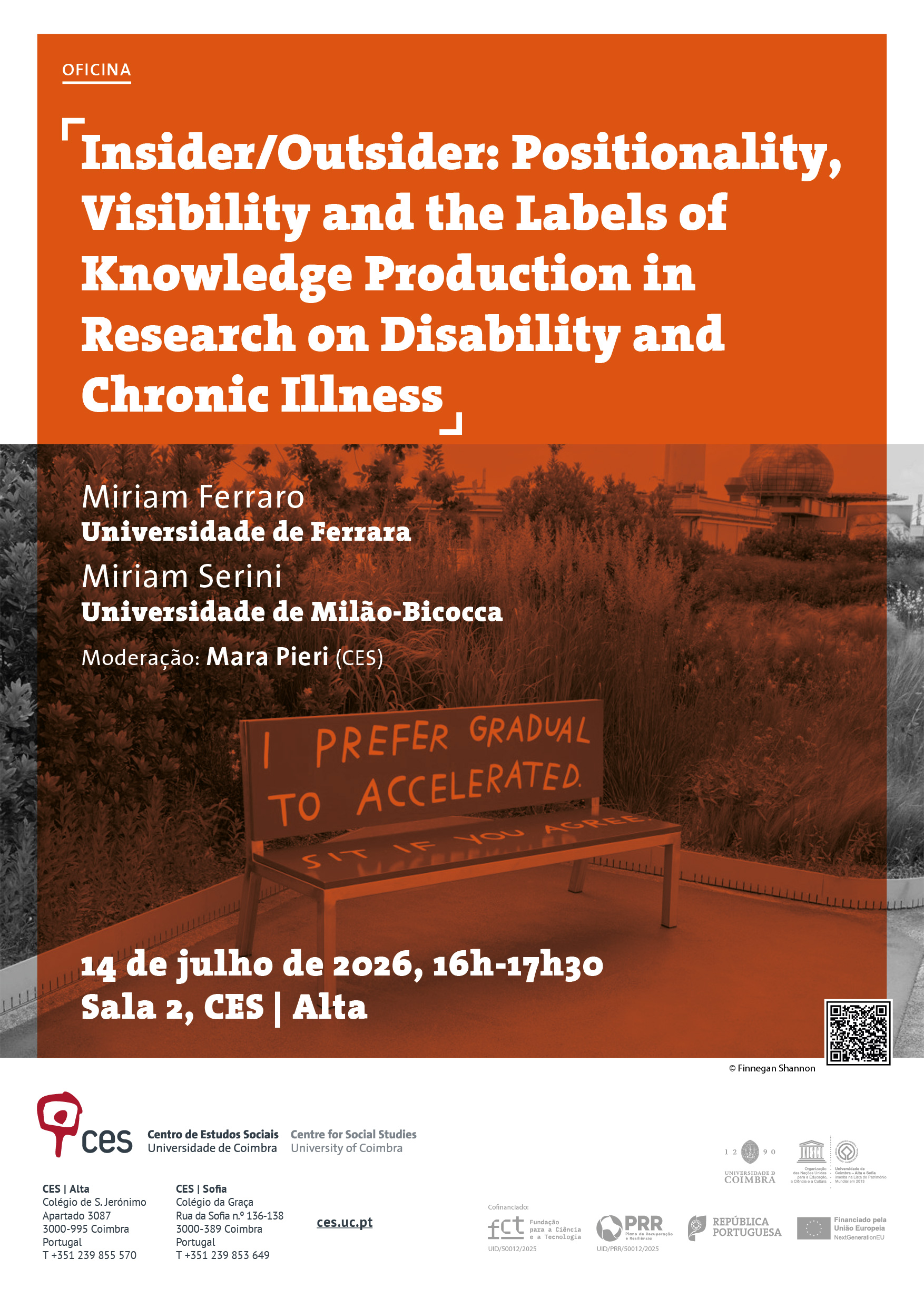
Insider/Outsider: Positionality, Visibility and the Labels of Knowledge Production in Research on Disability and Chronic Illness
Miriam Ferraro
Miriam Serini
July 14, 2026, 16h00-17h30
Room 2, CES | Alta
This joint contribution stages a dialogue between two researchers positioned on opposite sides of the insider/outsider axis, in order to interrogate a problem they hold in common: the conditions under which a person comes to be recognised as a legitimate producer of knowledge about marked bodies and minds.
Miriam Serini examines the methodological and epistemological implications of researching neurodivergence from a neurotypical position, drawing on cripistemology to question forms of social research built around neurotypical assumptions about communication, temporality, participation and self-narration.
Miriam Ferraro examines what it means to carry and make visible an invisible label within research and academia, drawing on feminist standpoint theory to explore how reflexivity, one of the field's most important contributions, can be practised in ways that question rather than reassure. By staging this dialogue, we aim to open a space for discussing questions of positionality and epistemic justice: who is recognised as a legitimate producer of knowledge regarding non-conforming bodyminds? What is made (in)visible in the act of knowing and being known? And what does it mean to assume the position of in/outsider in the context of research?
The event will be held in English
Bio notes
Miriam Serini holds a BA in Political Science and International Relation from the University of Roma Tre and a MA in Sociology from the University of Milan-Bicocca. She is a PhD candidate at University of Milan-Bicocca. Her main research interests are public policy, local welfare, crip studies and inclusive education. She is currently interested in the study of neurodiversity and urban space, focusing on both the analysis of public action and how neurodiverse people themselves inhabit public space.
Miriam Ferraro is a PhD candidate in Humanities at the University of Ferrara, Italy. Her research focuses on health, disability, and media studies, with particular attention to digital health narratives, neurodiversity, and online activism. She employs qualitative and critical discourse analysis methods to investigate experiences of illness, identity, and social inclusion. Her work explores how digital platforms shape knowledge, representation, and healthcare experiences.