
ECOSOC - Oficina de Ecologia e Sociedade
Workshop
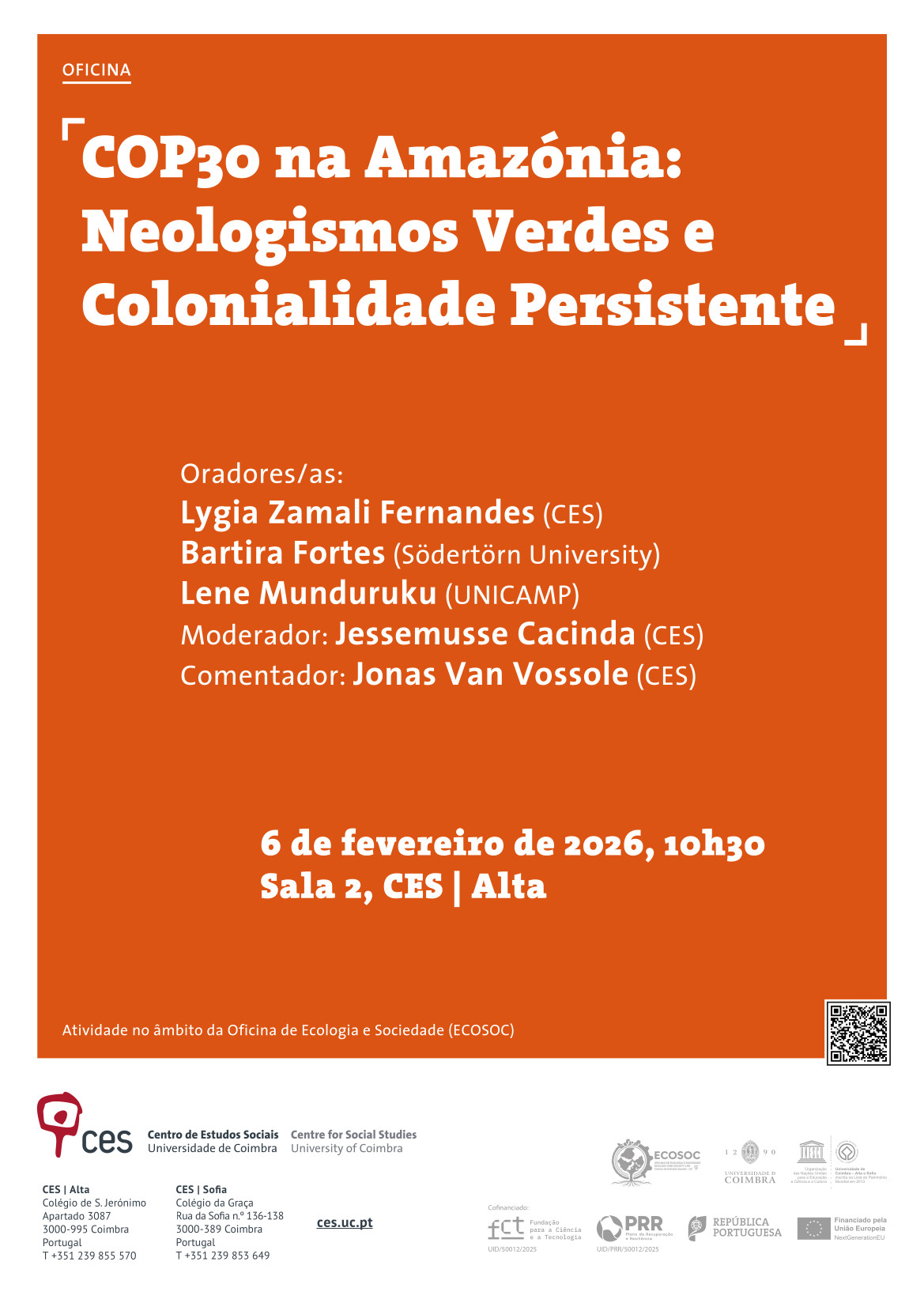
COP30 in the Amazon: Green Neologisms and Persistent Colonialism
February 6, 2026, 10h30
Room 1, CES | Alta
At the end of 2025, COP30 brought together political leaders, international organisations, companies and social movements in Belém do Pará, as is traditional, to discuss and seek solutions to climate change. This edition was particularly symbolic as it was held in the Amazon - one of the territories most affected by climate change and, at the same time, one of those with the greatest potential for solutions and alternatives.
From a decolonial perspective, this workshop proposes an assessment and critical analysis of the final outcomes of COP30, with particular attention to the epistemological, political, and practical weaknesses of solutions that rely primarily on financial mechanisms. We will discuss how environmental neologisms contribute to the reproduction of the coloniality of power, knowledge, and nature, especially in relation to the peoples of the forest - indigenous peoples and traditional communities - and how such solutions do not replace the role of the state in guaranteeing fundamental rights. Thus, we propose a critical reflection on alternatives grounded in rights, environmental justice, and strengthening the State, as opposed to financial solutions presented as “magical”.
Speakers
Lygia Zamali Fernandes | I was born in Santarém do Pará, a city located between the two largest urban areas in the forest, and I spent part of my childhood and youth in the city of Itaituba, both cities surrounded by the Tapajós National Forest, Amazonia - Brazil.I have worked and developed community-based socio-productive inclusion projects, protection for children and adolescents from traditional peoples and communities, and improvement of public social protection policies within the scope of the National Social Assistance Policy: Food Security and Solidarity Economy. I have a bachelor's degree in Social Work - an applied social science. I have worked with public policy and projects in the region since before completing my bachelor's degree. I also completed an MBA in Project Management at the University of São Paulo, as well as a postgraduate course in Social Economics at the University of Coimbra, and I have participated in project development and community strengthening efforts in the territories of traditional peoples and communities in the Amazon region.
Bartira Fortes | Anthropologist, artist and singer, she is a PhD candidate in Environmental Studies at Södertörn University (Stockholm), in the Department of Environment, Development and Sustainability Studies. Her research focuses on indigenous territorialities in Brazil, analysing how indigenous peoples face and respond to contemporary global challenges such as the climate crisis, environmental governance and socio-environmental (in)justices. In particular, she investigates the ways in which indigenous communities expand their territories by asserting agency in institutional, cultural and virtual spheres, encompassing political participation, academic knowledge production, contemporary art, cinema and digital activism.
Lene Munduruku | She holds a degree in Pedagogy and a Master's in Education from UNICAMP, where she was a member of the Uirapuru Indigenous Academics collective and conducted research on the experiences of indigenous students. She is currently a doctoral student in the Graduate Programme in Education (PPGE) at the Faculty of Education of the State University of Campinas (UNICAMP). She is a member of the Indigenous Studies Group in Higher Education (FE and IFCH-UNICAMP) and the Centre for Anthropology of Educational Processes (CEAPE-FE-UNICAMP). She currently participates in the Guatá Programme of Campus France (Brazil–France), with activities at the Université Paris-Est Créteil and the Université Paris 8.
Commentary
Jonas Van Vossole | Sociólogo, economista e doutor em Ciência Política, é investigador no Centro de Estudos Sociais da Universidade de Coimbra, onde co-coordena o grupo de investigação em Ecologia Política (ECOSOC). Integra a equipa coordenadora do projeto FCT EJMAPPING sobre conflitos ambientais, a rede COST Action SHIFT sobre Humanidades e Alterações Climáticas e o Observatório do Trabalho e das Condições de Vida, além de ter colaborado com o projeto Just2CE, financiado pelo programa Horizonte 2020. É professor convidado em cursos de licenciatura e doutoramento na Faculdade de Economia da Universidade de Coimbra, lecionando sobre Capitalismo, Ecologia Política e Democracia. Suas pesquisas atuais concentram-se em teoria crítica, teoria democrática, eco-marxismo e transição verde.
Sociologist, economist and PhD in Political Science, he is a researcher at the Centre for Social Studies at the University of Coimbra, where he co-coordinates the Political Ecology research group (ECOSOC). He is a member of the coordinating team of the FCT EJMAPPING project on environmental conflicts, the COST Action SHIFT network on Humanities and Climate Change, and the Observatory of Work and Living Conditions, and has collaborated with the Just2CE project, funded by the Horizon 2020 programme. Van Vossole is a guest lecturer in undergraduate and doctoral courses at the Faculty of Economics of the University of Coimbra, teaching on Capitalism, Political Ecology and Democracy. His current research focuses on critical theory, democratic theory, eco-Marxism and green transition.
Moderator
Jessemusse Cacinda | PhD candidate in Post-Colonialisms and Global Citizenship at the University of Coimbra, he studied Philosophy and Sociology in Mozambique. He has worked as a journalist, editor, project manager, teacher and researcher. As a journalist, he won the Radio Mozambique Quality Award in the categories of Best Chronicle (2013) and Best Thematic Reporting (2024).
Activity under the scope of ECOSOC - Ecology and Society Lab (CES-UC)